Does Splurging on a Better Bird Actually Save You Cash? We Did the Math
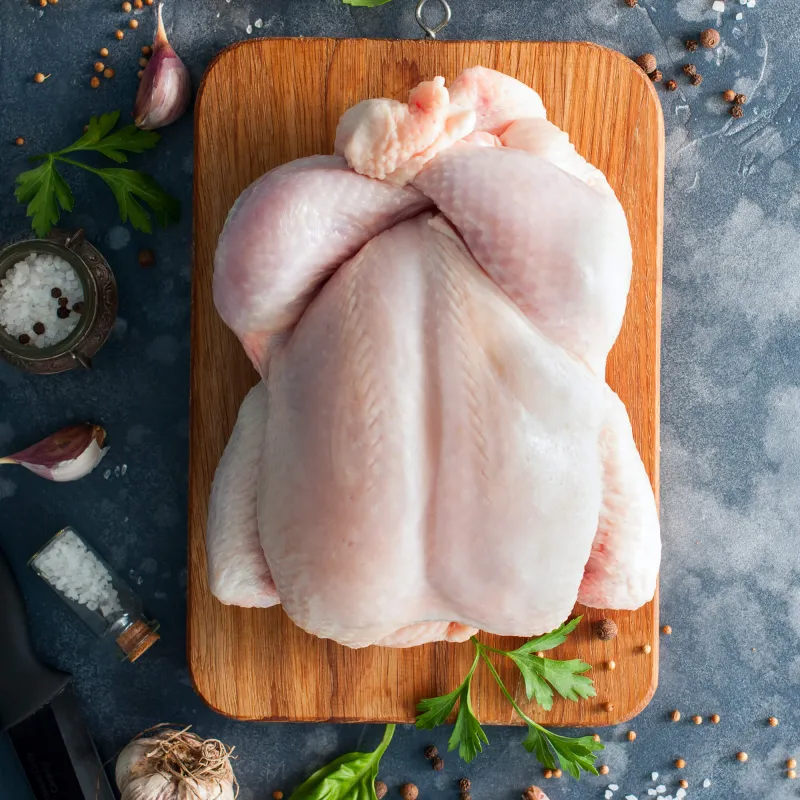
Photo: whole pasture-raised chicken on wooden cutting board with vegetables farm kitchen, via repprovisions.com
Walk into any grocery store in America and you'll find a whole chicken for somewhere between $1.50 and $2.50 per pound. Walk into a farmers market or open up a farm-direct box subscription, and that number can jump to $6, $8, even $10 per pound depending on the farm and the breed. The sticker shock is real. We get it.
But here's the thing — if you've ever cooked both side by side, you already know they're not the same product. And when you sit down and actually run the numbers, the gap between "cheap" and "quality" gets a lot narrower than the price tag suggests. In some cases, it disappears entirely.
Let's break it down.
The Yield Problem Nobody Talks About
A conventional broiler chicken — the kind that's been bred for rapid growth and raised in high-density housing — carries a lot of water weight. Processors routinely enhance these birds with saline solutions, sometimes adding 10 to 15 percent of the total weight in retained liquid. That's water you're paying for, and it's water that evaporates the moment heat hits the pan.
A pasture-raised or heritage-breed bird, by contrast, has denser muscle tissue and far less added moisture. When you roast a 4-pound conventional chicken, you might realistically yield around 1.5 to 1.75 pounds of usable meat. The same-weight farm-raised bird can yield closer to 2 to 2.25 pounds — sometimes more, depending on the breed.
Run that math: if you're paying $2 per pound for a 4-pound supermarket bird ($8 total) and walking away with 1.6 pounds of meat, your real cost per pound of edible protein is closer to $5. Meanwhile, a $7-per-pound farm bird at 4 pounds ($28) that yields 2.2 pounds of meat comes out to about $12.70 per pound of actual food. Still more expensive, yes — but not five times more. More like two and a half times. And that difference keeps shrinking as you factor in what comes next.
Stock, Bones, and the Art of Stretching a Bird
This is where home cooks who buy quality birds quietly win every single week.
A pasture-raised chicken has a robust carcass — real bones with actual collagen, not the hollow, papery frames you often get from fast-grown commercial birds. When you simmer those bones into stock, you get a rich, gelatinous broth that sets up in the fridge like loose Jell-O. That's collagen. That's flavor. That's the base for four or five more meals.
A good homemade stock from a quality bird can replace two or three cartons of store-bought broth, which run $3 to $5 each at most supermarkets. That's $6 to $15 in value you're extracting from what most people throw in the trash. Add that to your yield math, and the premium bird starts looking like a bargain.
Conventional carcasses can still make stock, but the result is thinner, less flavorful, and far less nutritionally dense. You'll often need to add more aromatics and simmer longer just to coax out something worth using.
Nutrition Isn't Just a Buzzword Here
Pasture-raised chickens — birds that spend meaningful time outdoors foraging on grass, insects, and varied forage — have been shown in multiple studies to carry higher levels of omega-3 fatty acids and vitamins like B12 and D compared to conventionally raised birds. They also tend to have better ratios of omega-3s to omega-6s, which matters if you're paying attention to inflammation and long-term health.
Now, we're not here to write a nutrition textbook. But consider this: if a higher-quality protein source means you're more satisfied after a meal and less likely to reach for snacks, or if it contributes to better health outcomes over time and fewer doctor's visits, those are real economic considerations too — just harder to put on a spreadsheet.
Food has always been medicine. Somewhere along the way, cheap industrial food convinced us that price and value were the same thing. They're not.
Waste Is Where the Budget Really Bleeds
Here's a stat that should rattle anyone who buys the cheap stuff: Americans throw away roughly 30 to 40 percent of the food they purchase. Chicken is one of the most commonly wasted proteins in the country.
Part of that waste comes from texture and flavor fatigue. Bland, rubbery chicken that was overcooked because it released too much moisture gets pushed around the plate and eventually tossed. A flavorful, properly raised bird — cooked simply, seasoned well — gets eaten. It gets picked clean. The leftover meat becomes tacos, grain bowls, or fried rice the next day. The bones become stock. The fat that renders out goes into a jar in the fridge and becomes the best cooking fat you've ever used for roasting vegetables.
Waste is expensive. A chicken you actually want to eat — one that tastes like something — is a chicken you'll use completely.
How to Make a Premium Bird Go the Distance
If you're ready to upgrade your chicken game without blowing your grocery budget, here's the practical playbook:
Buy whole birds whenever possible. Whole birds are almost always cheaper per pound than pre-cut parts, even from quality farms. Breaking one down yourself takes about ten minutes with a decent knife and pays dividends in cost savings.
Spatchcock for weeknight speed. Remove the backbone (save it for stock), flatten the bird, and you've got a whole chicken that roasts in 45 minutes instead of 90. Less time, crispier skin, more even cooking.
Portion strategically. Two breasts become two separate meals. Thighs and legs roast together for a third. The carcass and wings go straight into a stockpot. One $28 bird can realistically cover three to four dinners for two people — that's $7 to $9 per meal, which is competitive with fast food and infinitely better for you.
Render the fat. Chicken fat — schmaltz, if you want to get old-school about it — is a revelation. Save it from your roasting pan, strain it, and use it to sauté vegetables or make the crispiest potatoes of your life. It's free flavor you'd otherwise pour down the drain.
The Real Cost of Cheap Chicken
Beyond your grocery bill, there's a broader cost to consider. Conventionally raised chicken in the U.S. is often produced under conditions that rely heavily on antibiotics, which contributes to antibiotic resistance — a public health issue with trillion-dollar implications. The environmental cost of large-scale industrial chicken production, including water use, waste runoff, and feed crop land use, doesn't show up on your receipt either. But it's real, and it's being paid somewhere.
When you buy from a farm-direct source or a quality-focused box subscription, you're supporting a different model — one that's better for the animal, the farmer, the land, and ultimately, for you.
The Chicken Box Factory exists because we believe you deserve to know where your food comes from and that better chicken is worth the investment. Not because it's trendy. Because once you do the actual math — yield, stock, nutrition, waste reduction, and real cost per meal — it just makes sense.
Sometimes paying more upfront is the most economical thing you can do.
